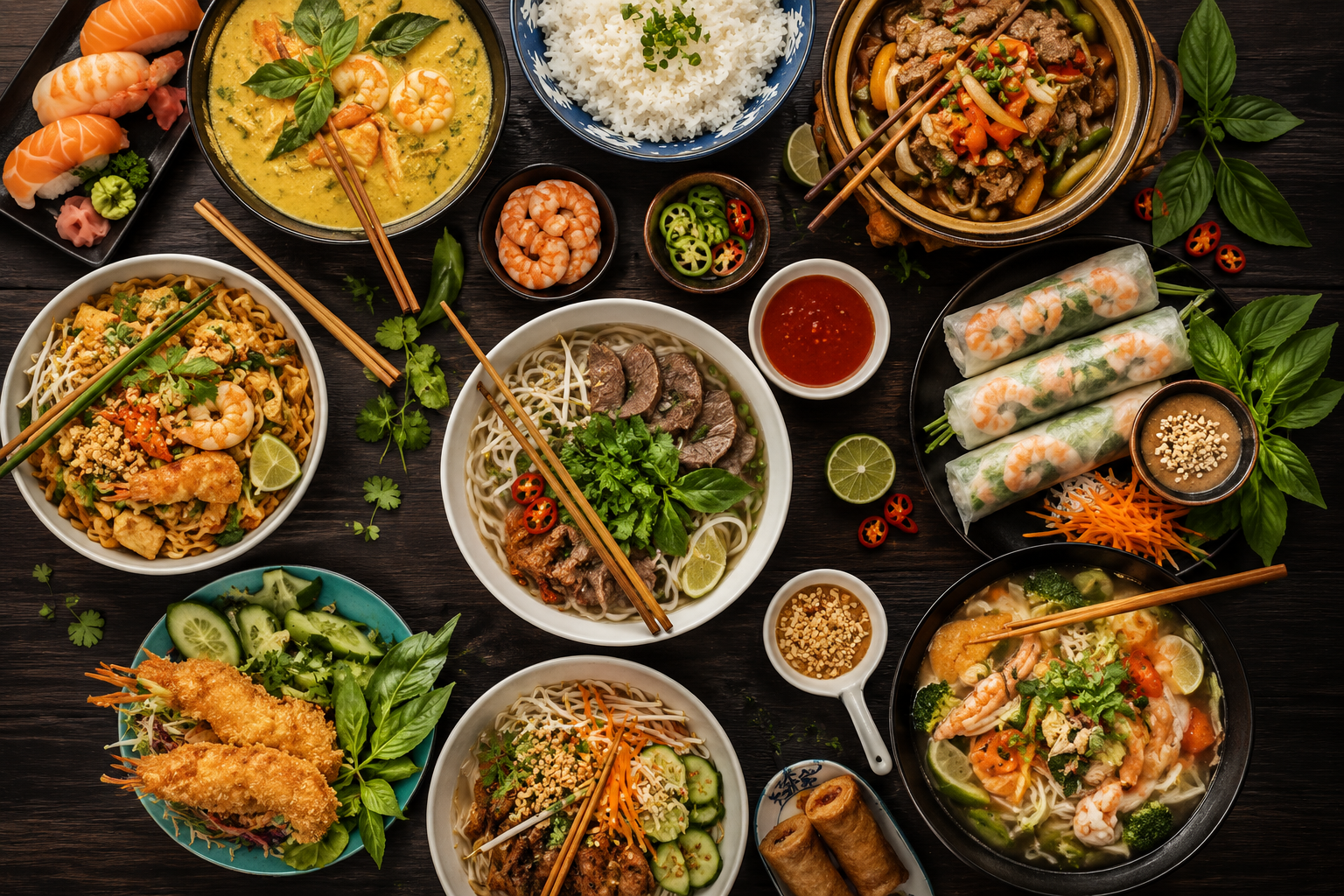
In Vietnam, no one eats alone if they can help it. The table is not simply where food is consumed. It is where family is gathered, where disputes are quietly resolved, where news is shared, where grief is carried together, and where the simplest ordinary Tuesday becomes something worth remembering. Food in Vietnamese culture is never just food. It is the language through which everything important gets said.
At Pho Van, we think about this every day. We are not just a restaurant. We are a continuation of something that began long before us, in kitchens on the other side of the world, around tables that shaped who we are. We want to tell you what food means in Vietnamese culture — and why, when you sit down with us, you are participating in something much larger than a meal.
In Vietnamese homes, the dinner table operates on its own unspoken rules. The youngest members of the family wait for the eldest to begin eating. Dishes are placed at the center for everyone to share. No one takes the last piece of something without offering it to someone else first. These are not formal rules written anywhere. They are absorbed through years of sitting at the table, watching, and eventually understanding.
The word Ăn cơm — literally “eat rice” — is used to mean simply “eat a meal,” regardless of whether rice is on the table. Rice is so foundational to Vietnamese life that the act of eating is named after it. To miss a meal in a Vietnamese household is not just inconvenient. It is noticed. Someone will ask why. Someone will save a plate. The table expects you back.
For Vietnamese families who left Vietnam — whether in the 1970s, the 1980s, or later — food became one of the most important ways to hold onto a home they could no longer reach. Recipes were carried in memory when nothing else could be brought. A bowl of phở made in a foreign country was not just dinner. It was proof that something essential had survived the crossing. It tasted like the streets of Hanoi or the kitchens of Saigon in ways that were hard to explain to anyone who had not been there.
That is why authenticity matters so much to Vietnamese cooks. Changing a recipe too much is not just a culinary choice. It is a small erasure of something that belongs to a place and a people. Every adjustment has to be earned. Every shortcut has to be justified. The food is not just food. It is a record of who someone was, and where they came from, and what they chose to carry forward.
"In Vietnam, the question ‘Have you eaten yet?’ is not about food. It is how you ask someone if they are all right."
Vietnamese culture marks every significant moment with food that is specific to that moment. Tết Nguyên Đán — the Vietnamese Lunar New Year — brings bánh chưng, sticky rice cakes wrapped in banana leaves and cooked overnight. The preparation itself is the celebration; families gather for hours around a fire, talking, sleeping, waiting for the cakes to cook, and the memory of that night together is as important as anything that gets eaten. Weddings bring elaborate multi-course feasts. Funerals bring offerings of the deceased’s favorite foods, set out so their spirit can return to eat one last time.
Even in everyday life, certain foods belong to certain moments. Phở is morning food — something you eat early, quietly, to set yourself right before the day takes over. Bún is afternoon food. Cơm tấm is the food of workers and street stalls. Each dish carries a time, a place, a feeling. To eat them out of that context is not wrong, but to eat them in it is something else entirely.
The Vietnamese proverb “Học ăn, học nói, học gói, học mở” translates roughly to “Learn to eat, learn to speak, learn to wrap, learn to open.” It is one of the most quoted sayings in Vietnamese culture, and it places eating first among the fundamental things a person must learn. The way you eat reflects your character, your upbringing, and your respect for the people at the table with you. It is one of the first things children are taught, and one of the last things the elderly stop caring about.
When the Pho Van family came to Charlotte, they brought all of this with them. Not just the recipes. The understanding that a bowl of soup placed in front of someone is an act of care. That the broth took hours because the person eating it deserved hours. That the herbs are fresh because anything less would be a failure of respect. That the table you sit down at here is connected, through an unbroken line, to tables in Vietnam that looked and smelled and felt very similar to this.
We know our regulars by name. We remember that some of them are here because it reminds them of somewhere they can’t go back to. We know that some of them have never been to Vietnam at all, but they have found something at this table that feels true and warm and worth coming back to. That is what Vietnamese food is supposed to do. It is supposed to make you feel like you belong somewhere.
Every bowl we send out of this kitchen carries that intention. Come back as often as you need to.
Food is better shared.
Come sit at our table. We’d love to have you.